Are you at a turning point in your life, unsure what needs to change or how to begin?Do you feel stuck in anxiety, emotional overwhelm, relationship difficulties, health-related stress or a sense that something no longer fits?Are you not sure exactly what you feel, what you need, or which part of you is trying to be heard?Do other people seem to be sure about what you should do, while you feel numb, conflicted, disconnected or pulled in too many directions?Are you looking for a space to slow down, explore what is happening beneath the surface and begin to understand yourself, your relationships and your next steps with more clarity?This is a space where you can slow down, reconnect with yourself and begin to find your way towards a life that feels more like your own.
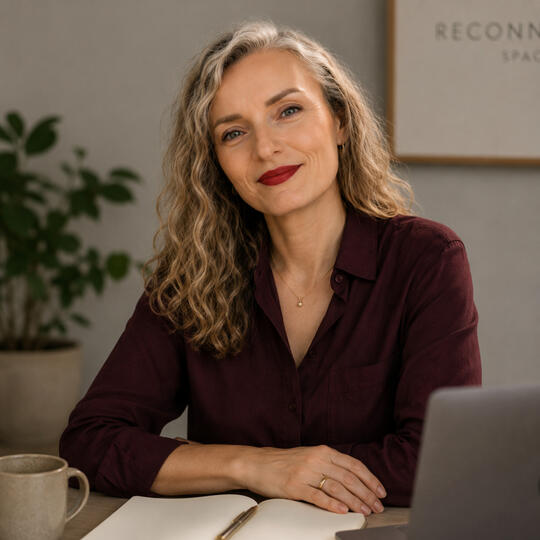
Hi! I'm Maria.
Psychologist with systemic & narrative therapy training, consultant, educator, mediator
& Mum of three.Supporting anxiety, relationships, health-related stress, life transitions
& finding a calmer way forward.
Much of my work centres around moments of change, uncertainty and transition.My journey with psychology began when I was barely a teenager. I completed my MSc in Psychology in 2009, with a focus on clinical and health psychology. During my studies, I fell in love with systemic therapy and began this part of my professional development in 2013.Since then, I have supported many people in finding their own way towards a calmer, more authentic relationship with themselves.Change does not always have to be dramatic to make a meaningful difference. Sometimes it begins with noticing a pattern, understanding a reaction differently or seeing an option that was not visible before.My systemic training helps me look beyond the individual problem and consider the wider context, including relationships, family history, health, identity, culture and the environments in which difficulties develop. This perspective can help you recognise your own strengths, understand what may be holding you back and explore different ways forward.I have developed my own programmes, materials and practical toolkits for individuals, couples and families. They are designed to support reflection, self-understanding, emotional regulation and a stronger sense of trust in yourself and your decisions.You do not need to know exactly what is wrong or what should happen next.My role is not to provide ready-made answers, but to help you understand yourself more clearly, make sense of what is happening and explore what a calmer, more connected way forward might look like. Through this process, you may begin to recognise your individual strengths, see options you had not considered before and reconnect with parts of yourself that have been overshadowed by your upbringing, stress, trauma, fear or survival mode.I am particularly interested in the places where relationships, emotions, health, identity, family history and life transitions meet, because these are often the places where people feel most stuck and most alone.I believe meaningful change rarely starts with pushing harder. More often, it begins with understanding, curiosity and enough safety to listen to what has been trying to be heard.
Maria Zakrzewska
Psychologist
Anxiety • Emotional Eating • Relationships • Nervous System Regulation • Identity • ADHD • Trauma • Stress • Burnout and more
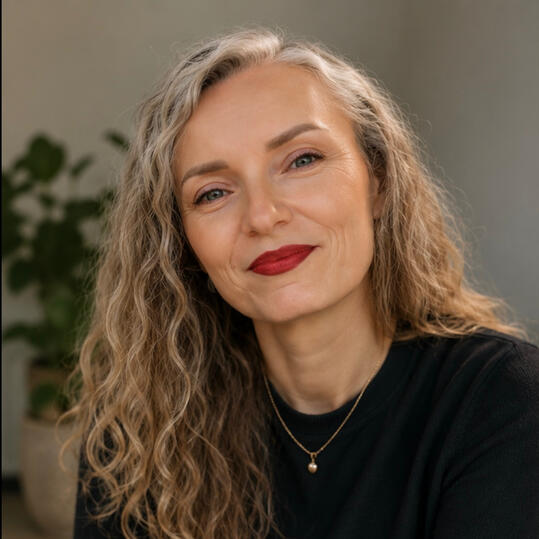
About me
As a Clinical Psychologist with additional training in systemic therapy*, narrative and EFT approaches, family mediation and psychological consulting, I support individuals, couples and families through anxiety, nervous system dysregulation, burnout, emotional overwhelm, relationship difficulties, ADHD/ AuDHD, health-related challenges and major life transitions.Alongside my professional experience, I bring the perspective of someone who has lived abroad for more than half of my life, built a life across cultures and languages, and navigated many of the challenges that come with health, relationships, parenthood and change. I am also a wife and a mother of three, experiences that continue to deepen my understanding of family dynamics, resilience and connection.Areas of work may include:• Anxiety, stress and emotional overwhelm
• Neurodivergence, ADHD and AuDHD
• Relationship and communication difficulties
• Emotional eating, binge eating and body-related shame
• Parenting, co-parenting and family transitions
• Couples/ Family support after the childen leave the house
• 60+ couples support
• Health-related stress and adjustment to diagnosis
• Boundaries, self-worth and people-pleasing
• Burnout, life transitions and identity changes
• Trauma responses and family-of-origin patterns
• Coping behaviours and habits that feel hard to changeI also welcome LGBTQ+ clients, co-parents and people in diverse relationship structures, including ENM and polyamory, kink and BDSM community.Through Reconnected Space, I provide educational resources, workshops, and self-guided materials as well as specialised programmes focused on anxiety, emotional wellbeing, nervous system regulation, relationships, neurodiversity, and personal growth- helping you move from anxiety and survival mode toward a calmer, more authentic self, reconnect and build healthier relationships.If you're ready to explore a different way forward, start here:
*The content provided is educational in nature and is not a substitute for psychotherapy or clinical mental health care nor in crisis. It draws on systemic, narrative, trauma-informed and somatic approaches as well as the knowledge from psychology degree plus latest research, and is designed to complement, not replace, therapeutic work.Results of self-guided materials or 1:1 consultations are not guaranteed and are dependent on the individual. Previous results do not guarantee similar outcomes. Individual services are offered separately and are subject to local regulations and professional requirements. All services and guides purchased here are designed to support meaningful personal change, but it also requires time and participation on your part.*Maria's therapy training does not correspond with the German understanding of psychotherapy and thus such service is not offered. Her other qualifications are not fully recognised by the German health care system, but Master's in Psychology with clinical major is and this is why only a consulting and educational services are offered based on current legal standpoint.
Reconnected Space- Towards Series™
The Towards Series™ brings together focused, shorter-term programmes designed around specific experiences and challenges. They are created for people who do not want to begin longer-term therapy, but would prefer to focus on one particular area through practical tools, reflection and personalised support.

Reconnected Space- Towards Series™
The Out of the Loop Programme™If you're ready to explore a different relationship with anxiety, please fill out the form to enquire and explore working together.
Or click the link below to learn more about it and apply directly for the programme.
The Holding Habit™ Binge Eating Programme

Binge Eating ProgrammeYou've probably blamed yourself enough already. Promising yourself that tomorrow will be different. Trying harder. Being stricter. Starting again on Monday. Wondering why something that seems so simple feels so difficult.And somehow finding yourself back in the same place. Feeling frustrated. Ashamed.
Exhausted by the constant battle with food and with yourself.Perhaps food has become more than food. Maybe it's comfort at the end of a difficult day. A way to switch off when your mind won't stop. A moment of relief when life feels overwhelming. A way of coping with emotions that feel too heavy to carry alone.The eating is visible. What sits underneath often isn't.What if there is nothing wrong with you?What if binge eating is not a sign of weakness, failure or lack of willpower?What if these patterns make sense in the context of your life, your experiences and everything you have been carrying?What if your relationship with food is trying to tell a story that has never been fully understood?And what if understanding that story could be the beginning of lasting change?This programme was created to help you explore exactly that.The Binge Eating Programme is a structured 10-step personalised pathway combining 1:1 consultations, guided exercises, reflective homework, downloadable resources and practical psychological tools designed to support change between sessions.Together we explore:
• binge eating and emotional eating patterns
• emotional triggers and coping strategies
• shame, perfectionism and self-criticism
• emotions, needs and boundaries
• self-worth and body image
• family, cultural and life experiences that may shape your relationship with food
• alternative ways of responding to difficult emotions and situationsA structured programme, tailored to you.My approach combines psychology, systemic and narrative perspectives, practical tools and personalised support.Rather than focusing solely on food itself, we also explore the wider context of your life, relationships, emotions, beliefs, habits and coping patterns.There is no expectation to be perfect. No judgement. No food rules. No pressure to change overnight. And no assumption that lasting change comes through criticism or control.WHAT MAY START TO CHANGEOver time, this programme is designed to support you in understanding your triggers with more compassion, developing healthier ways of responding to stress and difficult emotions, and reducing the amount of space food takes up in your mind.Imagine a life where food no longer takes up so much space in your mind, where eating is not followed by shame, when difficult emotions do not always have to become a battle with food. Where you can understand your patterns instead of punishing yourself for them, where you rather may begin to experience less guilt, less shame and more self-compassion.The aim is not another diet, another set of rules or another cycle of self-blame.The aim is to help you better understand yourself, develop healthier ways of meeting your emotional and physical needs, and build a more peaceful, compassionate and sustainable relationship with food and with yourself.If you're ready to stop seeing yourself as the problem, stop fighting and build a more peaceful relationship with food, please complete the form below to learn more about the programme.
Reflections on anxiety, emotions, relationships and the ways we try to cope
Free resources- new guides and workbooks.
Coming soon.
NewsletterReceive monthly reflections, new resources and updates on programmes and ways to work with me.

Reflections on anxiety, emotions, relationships and the ways we try to cope
When anxiety becomes a loop: why you cannot simply think your way out of it

Anxiety can make very ordinary things feel urgent.
A message is left unanswered. Someone sounds slightly different than usual. You notice a sensation in your body. There is a decision to make, a difficult conversation ahead, something at work that could go wrong.At first, it can seem sensible to think it through. To look at the situation from every angle. To prepare and plan properly. To make sure you have not missed anything important.But there is often a point where thinking stops bringing clarity and starts feeding the anxiety itself.Many people who struggle with anxiety already know that they overthink.
They may know that checking, researching, asking for reassurance or avoiding something only helps for a while.
They may have read about anxiety, listened to podcasts, tried breathing exercises or spoken about it before.
They may also have developed their own ways of coping: scrolling, procrastinating, dating, shopping, using drugs or alcohol, or simply keeping busy enough not to feel what is happening.Yet when anxiety arrives, that knowledge can feel very far away.
It is not that they are not trying hard enough. Anxiety is rarely just a thought or behaviour that can be replaced by a better one. It is often a pattern that has developed over time.A thought appears. Your body reacts. The thought begins to feel more convincing because your body is already on alert. You try to reduce the feeling by finding an answer, controlling the situation, preparing more, checking again or avoiding what feels difficult.There may be relief for a moment.
Then another thought, sensation or automatic action appears.The problem is not that these responses are irrational or pointless. In the moment, they often make complete sense. When something feels uncertain or threatening, of course you want to reduce that feeling. You may want to run away, stop your heart pounding or make your hands stop shaking. Of course you want to know what is going to happen.The difficulty is that anxiety can slowly teach you that uncertainty itself is dangerous. The more urgently you try to get rid of it, the less opportunity there is to learn that you may be able to stay with uncertainty and still be alright.Anxiety also does not appear in a vacuum. It can become louder during periods of change, exhaustion, illness, parenthood, financial pressure, conflict in a relationship or moving somewhere new. Sometimes it is connected to a much older way of being in the world.Perhaps you learned early that you had to be responsible. Maybe you became very good at noticing what other people needed before they said it. Maybe you learned to stay calm, not ask for much, avoid conflict or get everything right.
These things can become part of how you see yourself. You may think of yourself as organised, caring, independent or prepared.
And you may be all of those things.
But sometimes those qualities have also been shaped by the need to stay safe, accepted or connected to others. When that is the case, anxiety is not simply an unwanted symptom. It may be trying to do a job that once felt necessary.This is why asking, “What is wrong with me?” is rarely very helpful.A different question might be: “What is anxiety trying to protect me from?”That does not mean anxiety always has an accurate answer. It may tell you that something terrible is about to happen when it is not. But it can still be worth becoming curious about what it is responding to.
Is it uncertainty?The possibility of disappointing someone?The fear of being judged?The feeling that you are not allowed to make a mistake?The idea that you have to manage everything alone?Understanding the wider context does not usually make anxiety disappear straight away. But it can change the relationship you have with it. Instead of seeing it only as an enemy or a personal failure, you may begin to recognise it as a pattern that has become very strong.And patterns can change.
Not always quickly. Not through one insight or one perfect strategy. But through noticing what happens before the loop begins, learning what makes it stronger, and gradually finding different ways of responding.Sometimes that means pausing before checking something again. Sometimes it means saying out loud that you are feeling anxious instead of pretending everything is fine. Sometimes it means noticing that a familiar fear has appeared without immediately treating it as a fact.The aim is not to become someone who never feels anxious. That would probably be impossible, and perhaps not even desirable.
For me, working with anxiety is about creating a little more space around it, so that it does not get to decide everything: what you say yes to, what you avoid, how close you let people get or how much of your life you allow yourself to live.
If anxiety has been taking up more space in your life than you would like, you do not have to work through it alone.I offer support for people who want to understand their anxiety in context and begin relating to it differently. You can explore the ways we might work together here.
When your nervous system is stuck in survival mode

Sometimes the body carries on long after a person has run out of capacity.You may finally have a quiet evening. The children or your partner are asleep, the work is finished for now, nobody needs an answer immediately.You sit down, and instead of relief there is restlessness. Your shoulders stay tense. Your mind begins to go through tomorrow. You reach for your phone without really deciding to. Or you feel nothing much at all.It can be confusing. From the outside, there may be no obvious emergency. But your body does not seem to have received the message that it is safe to stop.People often describe this as being in “survival mode”. It can mean feeling constantly on edge, unable to rest, easily overwhelmed, irritable, disconnected, numb, tearful or as though everything is just one thing too many.But survival mode is not only something happening inside one person’s nervous system.It is often connected to the relationships, roles and expectations around them.Someone may have become used to being the person who keeps things going. The one who notices what needs doing, remembers appointments, smooths over conflict, anticipates other people’s needs, stays calm, earns enough, organises the family, manages the move, answers the messages or holds everything together when someone else is struggling.These roles do not usually appear by accident.They may have developed in childhood, in a relationship, at work, after becoming a parent, during illness, migration, financial pressure or a difficult period in the family.They may have brought a sense of purpose, closeness, safety or belonging. Other people may have come to rely on them.And over time, it can become hard to know where responsibility ends.
For some people, rest begins to feel less like rest and more like a risk.What might happen if I stop paying attention?Who will notice?What will fall apart?Will someone be disappointed in me?Will I still be needed if I am not the one holding everything together?These questions may not be fully conscious. They can show up as tension in the body, difficulty sleeping, a need to stay busy, or an inability to settle even when nothing urgent is happening.In relationships, these patterns can become shared.For example, one person may take on more and more of the planning, emotional labour or practical responsibility. The other may step back, become more passive, or feel criticised and shut down. The more one person over-functions, the more the other person may withdraw. The more the other withdraws, the less safe it feels for the first person to stop.Neither person necessarily chose this pattern on their own. But over time, it can become the way the relationship works.The same can happen in families.
A child who learned to read the room early may grow into an adult who is very attuned to other people’s moods, but less sure of their own needs.
Someone who was praised for being “easy”, “mature” or “independent” may find it difficult to ask for help later on.
A parent who had little support may become so used to coping alone that receiving care feels uncomfortable or even unsafe.This does not mean everything can be explained by childhood, or that anyone needs to be blamed.It means that the body often remembers patterns of relationship, responsibility and safety even when we are no longer in the same circumstances.That is why telling yourself to “just relax” rarely gets very far.A system that has learned to stay alert needs more than good advice. It may need different experiences, repeated over time.
More predictability. More support. More room to say no.
Fewer situations where everything depends on one person coping perfectly.Sometimes the ways people cope make sense when we look at the wider picture.Scrolling late at night may be the only time that feels truly private. Procrastination may be a response to pressure that has become too much. Drinking, shopping, dating, working constantly, avoiding messages or keeping busy may offer a brief break from feelings that are difficult to name or make space for.These responses can bring relief, even when they later create other problems.
That does not mean they are meaningless or that a person simply needs more discipline. It may be more useful to ask what they are helping someone get through.What becomes harder to feel when you keep moving?What does slowing down make room for?What are you carrying that no one else seems to see?And what would need to change around you, not only inside you, for your body to have a little less reason to stay on guard?This is also where language matters.
“I am anxious” can sometimes make anxiety sound like a fixed part of who you are.It can be different to say: “Anxiety becomes louder when I feel responsible for everyone”, or “I notice that I cannot rest after conflict”, or “My body goes into alarm when I think I might disappoint someone.”That does not make the feeling smaller. But it can make the pattern easier to see.And when a pattern becomes visible, there may be more than one way of responding to it.Working with survival mode is not about becoming calm all the time. There are situations where alertness is useful. It is about understanding what has made your body work so hard, and slowly creating more room for choice.That might include noticing earlier when you are overwhelmed. Looking at the roles you have taken on. Having conversations about what is shared and what is carried alone. Letting other people help, even if it feels unfamiliar. Building small moments of rest that do not need to be earned first.It may also mean paying attention to the exceptions.Are there people around whom you do not need to perform or stay prepared?Are there places where your body softens a little?Are there moments when you can feel tired without immediately having to push through it?Those moments matter. They are not proof that everything is solved, but they can show us that survival mode is not the whole story.If you recognise some of these patterns in your own life, you do not have to make sense of them alone.
I offer support for people who want to explore anxiety, overwhelm and emotional patterns in the context of their relationships, history and everyday life. You can explore the ways we might work together.
Avoidance, reassurance and control: the patterns that keep anxiety going

Anxiety often comes with a strong need to do something or to avoid it all entirely.To check the message again, ask whether everything is okay, cancel a plan, read one more article, prepare for every possible outcome before making a decision. Or the opposoite- scroll, shop, drink, smoke, eat, day dream... For a moment, these things can help. You get an answer, the tension drops, or you avoid the situation altogether. It feels easier to breathe.The problem is that the relief rarely lasts.A few hours later, there is another doubt. Perhaps the person replying to you sounds different. Perhaps you notice another symptom in your body or you start thinking about what could still go wrong.That is how anxiety can slowly take up more space in everyday life. Not always in dramatic ways. Sometimes it looks like spending too long writing a simple email, putting off a phone call, checking whether a door is locked three times, or needing someone close to you to tell you again that they are not angry. Even watching shorts or movies into the night, just not to fall asleep, or watch it for such a long time you cannot seem to fall asleep on your own anymore.None of this means that you are irrational, difficult, incopetent.When something feels uncertain, threatening or emotionally important, it makes sense to look for safety. Avoidance, reassurance and control are often ways of trying to get through a feeling that has become too intense.The difficulty is that they can also make anxiety stronger over time.If you always avoid the conversation, the journey, the appointment or the decision, your body does not get much opportunity to learn that you might be able to cope with it. If you always need reassurance before you can settle, uncertainty can begin to feel unbearable on its own.Control can work in a similar way.It may show up through planning, overthinking, organising, researching, managing money carefully, watching what people say, or trying to get everything exactly right. Some of these things may be useful and part of who you are. Being organised is not a problem in itself. But it can become exhausting when there is no room left for things to be unclear, unfinished or out of your hands.Sometimes this is especially visible in relationships.One person may start asking for reassurance more often: “Are you upset with me?”, “Did I do something wrong?”, “Are you sure everything is fine?”The other person may try to reassure them at first. They explain, comfort, send longer messages, answer quickly or change their plans to avoid making things worse.Both people may be trying to take care of the relationship.But after a while, the pattern can become tiring. The person who is anxious may feel ashamed for needing so much reassurance. The other person may begin to feel watched, pressured or unsure how to respond. They might pull away, become impatient or avoid certain conversations.Then the anxiety often gets louder, because the pattern has started to do more of the talking than either of them.The same can happen with control in families, work or friendships. Someone becomes the person who remembers everything, notices everything, organises everything and makes sure nothing is forgotten. Other people may come to rely on that. Over time, it can become hard for the person carrying all of this to stop, even when they are exhausted.They may not feel that they have a choice.Sometimes these patterns are connected to earlier experiences. Perhaps you grew up around unpredictability, conflict or people whose moods changed quickly, being prepared helped you avoid criticism or disappointment, you learned that being responsible was the safest way to stay connected to others.That does not mean every anxious pattern comes from childhood, and it does not mean anyone needs to be blamed.But it can help to understand that these behaviours often had a reason. They may have helped you cope at another time in your life, even if they are now making life smaller.Instead of asking, “Why do I keep doing this?”, it may be more useful to ask what happens when you do not.What are you afraid might happen if you do not check?What feels risky about leaving a message unanswered?What does it mean to you if someone is disappointed, distant or upset?What becomes difficult when you let someone else take responsibility?These are not always easy questions. They can bring up things that are connected to relationships, family roles, past experiences or the pressure you put on yourself now.Working with anxiety does not mean forcing yourself to stop every anxious behaviour overnight. That usually becomes another thing to get right.It can begin much more simply. You might notice the moment before you check again. You might wait a few minutes before asking for reassurance. You might tell someone, “I am feeling anxious, and I do not need you to solve it, but I would like some support.”Small changes matter, especially when they are made with curiosity rather than self-criticism.If anxiety has started to shape your decisions, relationships or everyday life, you do not have to make sense of it on your own.I offer support for people who want to understand anxiety in the context of their lives, relationships and the patterns they have learned over time. You can explore the ways we might work together.
The right format, lenght of sessions and the lenght of the process depends on your needs, goals and current situation and that is why I do not publish a fixed full price list here. Instead, I offer a clear fee range and send the most relevant option after initial contact.
Fees range
Individual support: from €90 per sessionCouples, families and ENM/ poly relationships: from €100 per sessionSpecialised formats e.g. Separation Rituals: from €150 per session
Sessions may be booked as single consultations, ongoing support, or as part of a structured programme.
Structured programmesI also offer structured support pathways for people who want a more focused process rather than open-ended sessions. These are offered only after initial contact, so we can check whether the format is appropriate for your needs.
Self-guided materialsSome resources may also be available as self-guided materials for people who are not ready for sessions, prefer to work at their own pace, or want a first step before booking support.
Workshops, events, group support
Please enquire directly
Before bookingYou are welcome to book a short 15-minute intro call or send an enquiry first. This helps me understand what you are looking for and suggest the most suitable option.A full offer, including the exact fee, session length, payment terms and relevant policies, is sent individually before we start working together.
Downloads and free materials coming soon.
In the meantime you can sign up for my newsletter.
Join a growing community of people interested in greater calm, self-understanding and more connected ways of living.Receive monthly reflections, new resources and updates on programmes and ways to work with me.
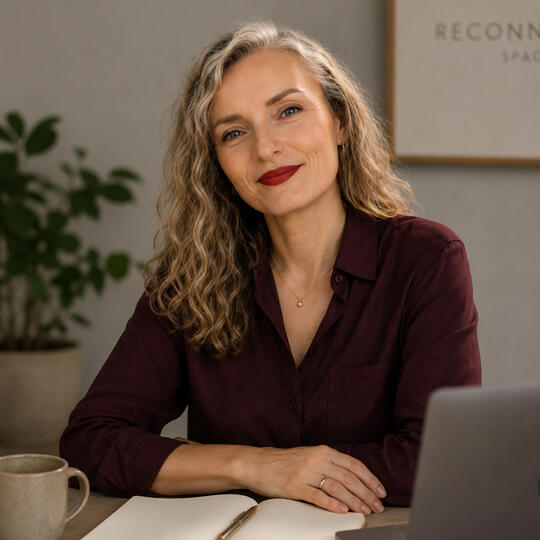
Together, we can explore key areas of your wellbeing, move toward calm, understanding and connection and create a long- lasting change.
Let's Find the Right Support for You
Whether you're interested in 1:1 support, couples or family consultations, or one of my Towards Series Programmes, please complete the short form below and I'll be in touch with the next steps OR book a 15' intro call.